
Table of Contents
- Introduction
- Why AI pilots don’t scale
- The wrong starting point
- The right starting point: process pain and decision bottlenecks
- Human-in-the-loop: who checks, approves, owns?
- AI governance: data, security, and accountability
- Readiness checklist for mid-sized companies
Introduction
Companies racing to adopt AI are skipping the most important step. The result is expensive pilots that never scale — and accountability gaps that multiply risk.
Every week, another vendor promises a faster route to AI transformation. Buy the platform, connect the data, watch the productivity soar. It is a compelling pitch — and it is almost entirely backwards.
The organizations that get lasting value from AI don’t start with tools. They start with a harder question: where are the decisions, the bottlenecks, and the accountability gaps in our work?
60%
of executives use AI in decision-making today
5%
say they actually manage it well
Deloitte, 2026

Why AI Pilots Don't Scale
Most AI pilots produce impressive demos. A chatbot that handles FAQs. A model that drafts proposals. A dashboard that summarizes reports. Then six months later, the pilot is quietly archived.
The failure is rarely technical. It is structural. The organization never mapped which decisions the AI would influence, who would remain accountable for those decisions, or what happens when the output is wrong. Without that foundation, automation doesn’t solve work — it accelerates confusion.
“AI does not fix unclear work. It multiplies it.”
The Wrong Starting Point
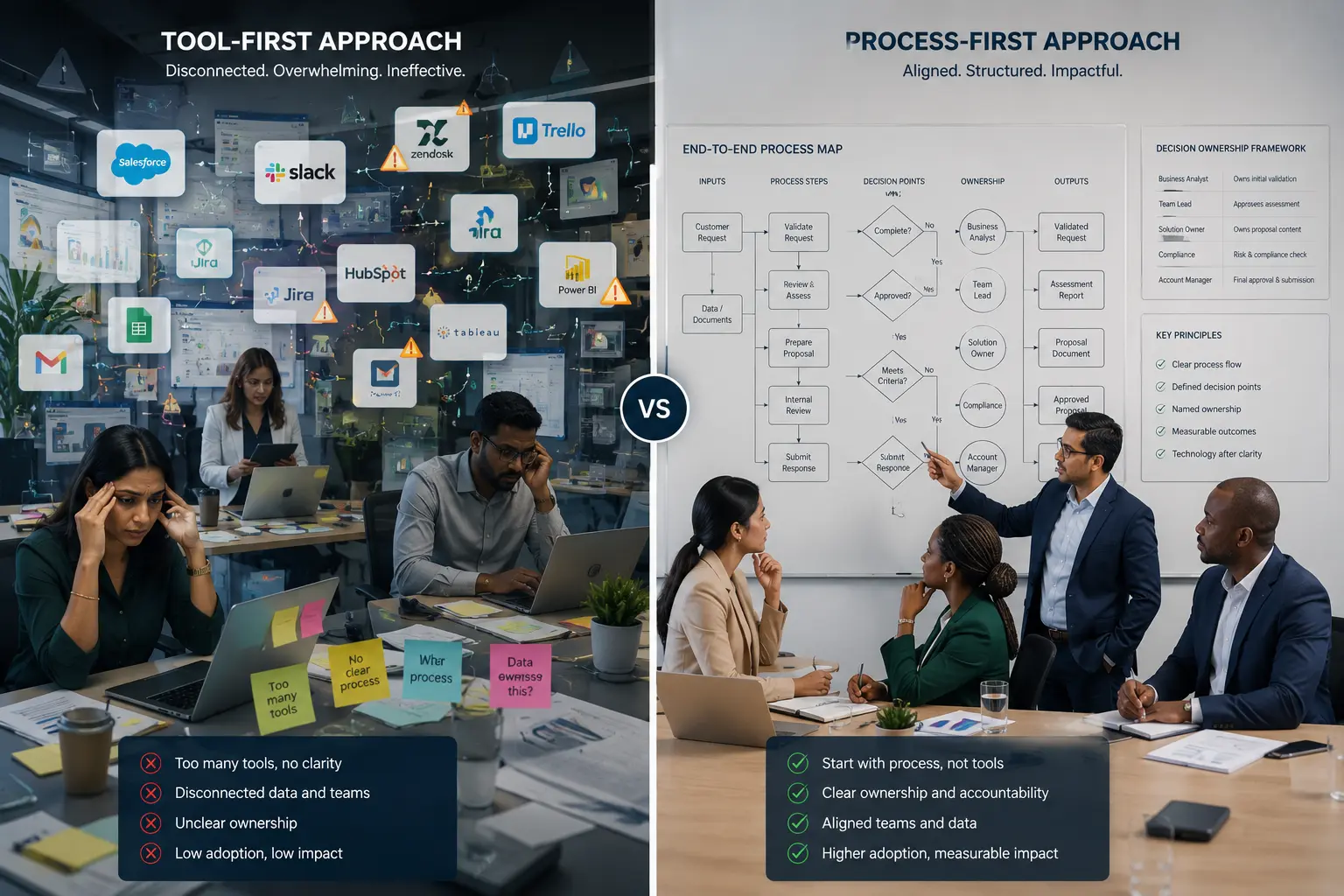
Tool-first AI adoption looks like this: a procurement decision followed by a rollout, followed by training sessions, followed by a search for use cases to justify the spend. The sequence is inverted.
Tool-first (common)
- Buy a platform or subscription
- Attend vendor demo
- Look for problems that fit the tool
- Wonder why adoption is low
- Scale to a larger team
Process-first (effective)
- Map decisions and bottlenecks
- Identify where data already exists
- Define ownership and review logic
- Choose a tool that fits the gap
- Scale what demonstrably works
The Right Starting Point: Process Pain and Decision Bottlenecks
Before any AI conversation, a mid-sized organization should answer four questions honestly.
- Where do decisions stall?
Approval chains, manual reviews, information waiting on one person — these are the places AI can compress cycle times. But only if the decision logic is already clear. - What data do we actually have — and is it clean?
AI is a pattern-recognition system. Inconsistent records, siloed spreadsheets, and undocumented processes produce unreliable outputs. The audit often reveals that the data problem was the real problem all along. - Which workflows have measurable outputs?
If you cannot define what good looks like without AI, you cannot evaluate whether AI is doing it. Precision matters here: not “improve customer service” but “reduce first-response time below 2 hours for category A tickets.” - What are the consequences of an error?
A low-stakes content suggestion is different from a compliance-sensitive approval. Risk tolerance shapes where AI should operate unsupervised and where it should always surface to a human.
Human-in-the-Loop: Who Checks, Approves, and Owns?
The human-in-the-loop model is not a fallback for when AI fails. It is the design principle from the start. For every workflow where AI contributes, three roles need to be named before deployment:
- Reviewer
Who reads the output before it becomes an action? What is their checklist? - Approver
Who can override or escalate? What triggers a mandatory human decision? - Owner
Who is accountable if the AI output causes a downstream problem?
These are not IT questions. They are organizational design questions. They require leadership to decide, not just technology teams to implement.

AI Governance: Data, Security, and Accountability
Governance is where many organizations take their first shortcut — and pay for it later. A working governance framework for AI addresses four areas.
- Data access controls. Which systems can the AI read? Who can expand that access? Uncontrolled data access is both a security risk and a compliance liability, particularly for organizations operating under DIFC or ADGM frameworks in the UAE.
- Audit trails. Can you reconstruct what the AI recommended, when, based on what inputs, and who acted on it? If not, you cannot investigate errors or demonstrate compliance.
- Vendor risk. When a third-party AI model processes your customer data or financial records, what are the contractual obligations on data retention, sovereignty, and breach notification? This question is often unasked until it is urgent.
- Model drift. AI outputs degrade over time as the world changes. Who monitors performance, on what schedule, and what is the threshold for intervention?
Readiness Checklist for Mid-Sized Companies
Use this as a working audit before committing budget to any AI initiative.
AI readiness — pre-investment audit
- We have documented which decisions currently create the most delays or errors
- We know which data sources are clean, current, and accessible
- We can define measurable success criteria for at least three workflows
- We have assigned a human reviewer role for any AI-assisted output
- We have named who is accountable if AI output causes a downstream error
- Our data access policies are documented and enforced
- We can produce an audit trail for any AI-influenced decision
- We have reviewed vendor data retention and sovereignty terms
- We have a process for monitoring AI output quality over time
- Leadership has discussed risk tolerance for AI errors in customer-facing workflows
“AI does not fix unclear work. It multiplies it.”
Best Assured helps mid-sized organizations in the UAE build the operational and governance foundations for AI — before the tools are procured. Talk to our team →