
Table of Contents
- Revenue Is Only One Measure of Business Strength
- The Hidden Cost of Scaling Fast
- Growth Exposes Weak Foundations
- Three Signs Growth Is Outpacing Control
- Why Uncontrolled Growth Matters More Than It Seems
- The Real Fix Is Stronger Systems
- Building an Operating System for Sustainable Growth
- Conclusion
Revenue Is Only One Measure of Business Strength
Most leadership teams treat revenue growth as the ultimate scoreboard. More clients, more contracts, more locations, and a higher topline appear to confirm that the business is winning.
Revenue is important, but it does not tell the complete story.
A company can increase sales while simultaneously weakening its cash position, overwhelming its employees, reducing service quality, and creating greater dependence on a few senior decision-makers. What appears to be progress on a financial statement may be creating operational pressure throughout the organization.
Growth without control does not necessarily strengthen a business. It stress-tests it.
The real measure of business strength is not simply how much revenue the company can generate. It is how effectively the organization can deliver that revenue without sacrificing quality, profitability, employee performance, customer experience, or leadership visibility.
The Hidden Cost of Scaling Fast
When revenue climbs faster than the systems supporting it, the cracks rarely appear immediately. In the early stages, teams often compensate through longer hours, informal coordination, and constant intervention from management.
The consequences become visible several months later.
Deadlines start slipping. Customer complaints increase. Employees begin working nights to manage orders they once fought hard to win. Managers spend more time resolving recurring problems than improving performance. Finance teams struggle to explain why higher sales have not resulted in stronger cash flow or profitability.
These problems are often treated as temporary growing pains. In reality, they may indicate that the organization’s operating capacity has not developed at the same pace as its commercial ambitions.
Scaling introduces greater volume, more transactions, additional employees, increased customer expectations, and more complex decisions. Without the right control mechanisms, every layer of growth adds pressure rather than capability.

Growth Exposes Weak Foundations
Growth exposes weak foundations. It does not create them.
A business running on informal processes, tribal knowledge, spreadsheets, verbal instructions, and founder-dependent decision-making may operate effectively at a smaller scale. The limited volume allows experienced employees and senior leaders to monitor activities personally.
As the company grows, that model becomes increasingly difficult to sustain.
More employees need clarity about their responsibilities. More customers require consistent service. More transactions demand stronger financial controls. More departments need reliable communication. More decisions must be made without waiting for the founder or senior management.
Every undocumented process becomes a potential inconsistency. Every unclear role becomes a possible accountability gap. Every manual report increases the risk of delayed or inaccurate information.
Growth therefore acts like a pressure test. It reveals whether the business has been built around repeatable systems or around the extraordinary effort of a few individuals.
Three Signs Growth Is Outpacing Control
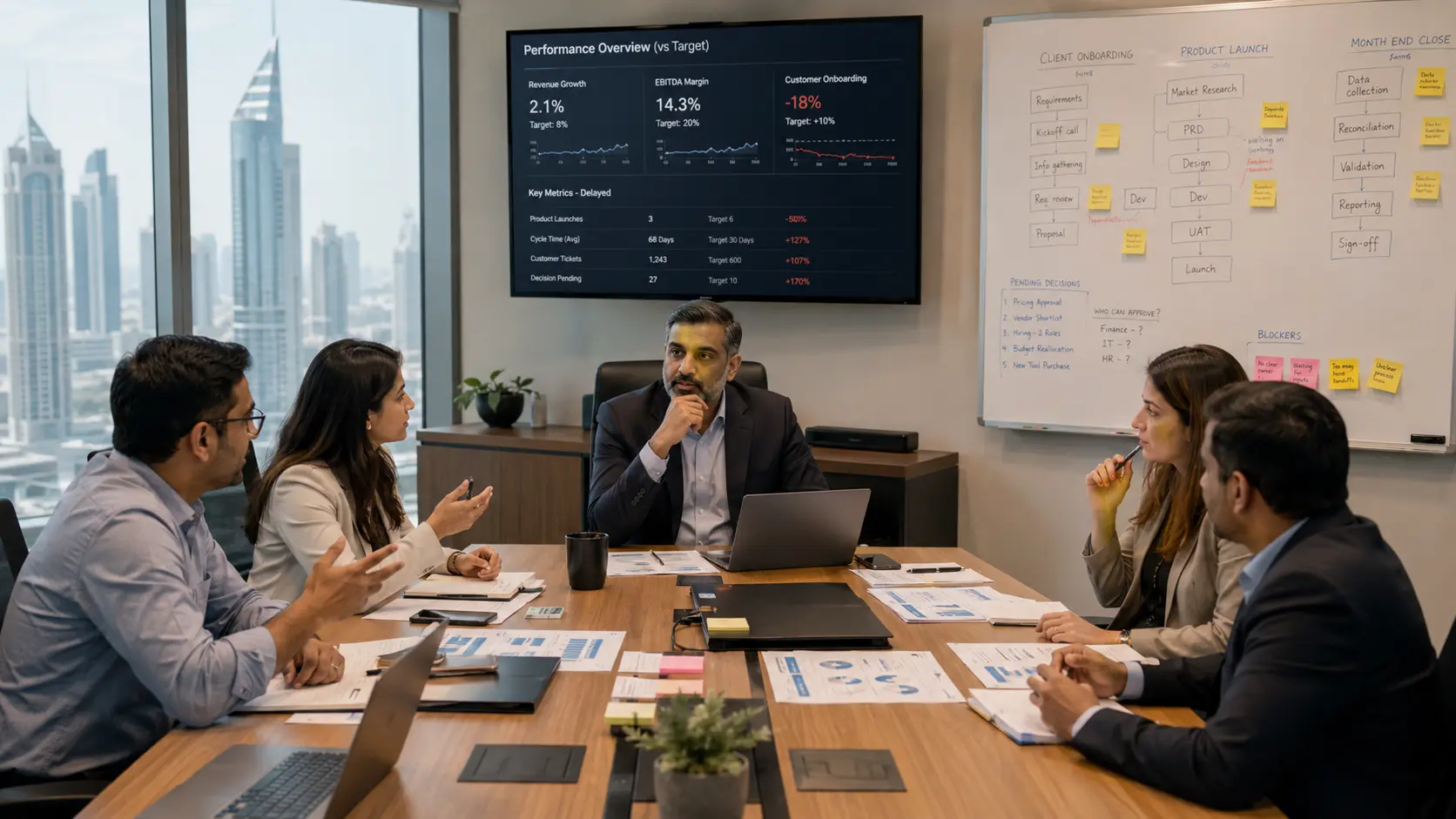
The first sign is that decisions bottleneck at the top. If every meaningful approval, exception, customer issue, or operational decision continues to route through one or two people, growth does not scale the business. It scales their workload. Eventually, those individuals become the ceiling for the organization.
The second sign is that processes exist in people’s heads rather than in systems. When the best-performing employee leaves and a large part of the institutional knowledge leaves with them, that is not simply bad luck. It is a structural risk that was always present but remained unrevealed.
The third sign is that performance data lags behind reality. If leadership learns about a problem from a customer instead of from its own metrics, dashboards, reviews, or internal controls, visibility has already been lost. By the time the issue becomes obvious, correcting it is usually more expensive.
Together, these signs indicate that the organization is increasing activity without creating the governance required to manage it.
Why Uncontrolled Growth Matters More Than It Seems
Uncontrolled growth creates more than operational friction. It compounds financial, cultural, and reputational risk.
Cash flow becomes strained because recruitment, inventory, technology, logistics, and delivery costs increase before customer payments are collected. A profitable order book can still create a liquidity problem if working capital requirements were never modelled.
Quality also begins to decline when oversight does not scale with volume. Employees may bypass checks to meet deadlines, customer communication may become inconsistent, and managers may approve work without sufficient information.
Culture is affected as well. When people spend most of their time firefighting, they have little capacity to improve systems, develop skills, or contribute strategically. High performers may experience burnout, while accountability becomes difficult to enforce because roles and expectations remain unclear.
The businesses that survive rapid growth are not always the ones that grow fastest. They are the ones that develop the infrastructure needed to absorb expansion.
The Real Fix Is Stronger Systems
The goal is not to grow less. It is to build the people, processes, and tools that allow growth to be absorbed instead of endured.
Decisions must be distributed through clear ownership rather than funnelled through one person. Employees need defined roles, measurable responsibilities, appropriate authority, and structured escalation mechanisms.
Processes must be documented, repeatable, and integrated into the systems employees use every day. A process should not depend entirely on memory, personal relationships, or the presence of one experienced team member.
Performance must also be tracked in real time. Leadership needs meaningful indicators covering sales, operations, finance, customer service, productivity, inventory, profitability, and cash flow. These metrics should identify risks early enough for management to act before the customer feels the impact.
Stronger control does not mean creating unnecessary bureaucracy. It means building sufficient clarity, visibility, and accountability to support faster and more confident execution.

Building an Operating System for Sustainable Growth
Sustainable growth requires an operating system that connects strategy with daily execution.
That operating system includes a clear organizational structure, defined reporting lines, documented standard operating procedures, performance metrics, review mechanisms, reliable financial reporting, capable managers, and technology that supports rather than complicates operations.
It should also include a continuous improvement process. When a problem occurs, the organization should be able to identify its root cause, implement corrective action, assign ownership, and prevent recurrence.
This shifts the business from reactive problem-solving to structured performance management.
A well-designed operating system also gives leaders more space to focus on strategy, market expansion, innovation, and relationships. Instead of becoming the approval point for every activity, they can build capable teams that make informed decisions within clearly defined boundaries.
Revenue can then increase without causing an equal increase in confusion, dependency, or risk.
Conclusion
Growth is not the risk. Ungoverned growth is.
Higher revenue can increase business risk when the systems supporting delivery, accountability, financial management, and decision-making remain underdeveloped. Without stronger foundations, growth can magnify existing weaknesses and turn manageable gaps into expensive problems.
The businesses built to last are not simply chasing the highest revenue number. They are building the operating system that makes higher revenue sustainable long after the initial push that created it.
When people understand their responsibilities, processes are repeatable, data reflects reality, and leadership has clear visibility, growth becomes more than an increase in sales. It becomes a controlled, resilient, and sustainable path forward.